
Declassified Election Intelligence Warnings: Election Security & New York's Election Infrastructure
Investigative Analysis – Part 1 by Brian Youmens, Project CIVICA volunteer


In his primetime address to the nation on July 16, 2026, President Trump released a set of declassified intelligence community materials that provided a detailed window into the threat environment surrounding U.S. elections. New York was identified by name in these documents. These assessments drawn from CISA’s ongoing election security reporting, National Intelligence Community Memoranda (NICM), CIA analytical products, and FBI commentary did not conclude that any foreign actor successfully altered vote tallies or changed the outcome of the 2020 presidential election in New York or nationally.
What they did document were concrete adversarial capabilities, reconnaissance activities, and persistent architectural weaknesses in the infrastructure that state and local election officials rely upon. As one declassified U.S. Intelligence Community assessment states:
“We judge that U.S. adversaries, including at a minimum Russia, China, Iran, and North Korea, as well as non-state groups, have the capability to compromise U.S. election infrastructure.”
Another assessment from the same release notes that:
“centralized election-related data repositories, such as voter registration databases, pollbooks, and official election websites, are most vulnerable to exploitation.”
(Both quotes appear in the declassified assessments released in the package Vulnerabilities in Electronic Voting and Ballot-Counting Systems.) The release also included reporting on China’s acquisition of approximately 220 million U.S. voter files beginning in the 2020 cycle. Independent reviews of the heavily redacted materials have noted that some of this collection involved publicly available or commercially obtained data. The intelligence record documents extensive collection and analysis of voter data for intelligence and influence purposes; it does not, on the materials released, establish successful alteration of voter rolls or vote totals in any U.S. election. Contemporaneous Intelligence Community judgments (including those issued in 2020–2021) likewise found no evidence of successful interference with vote tabulation or transmission.
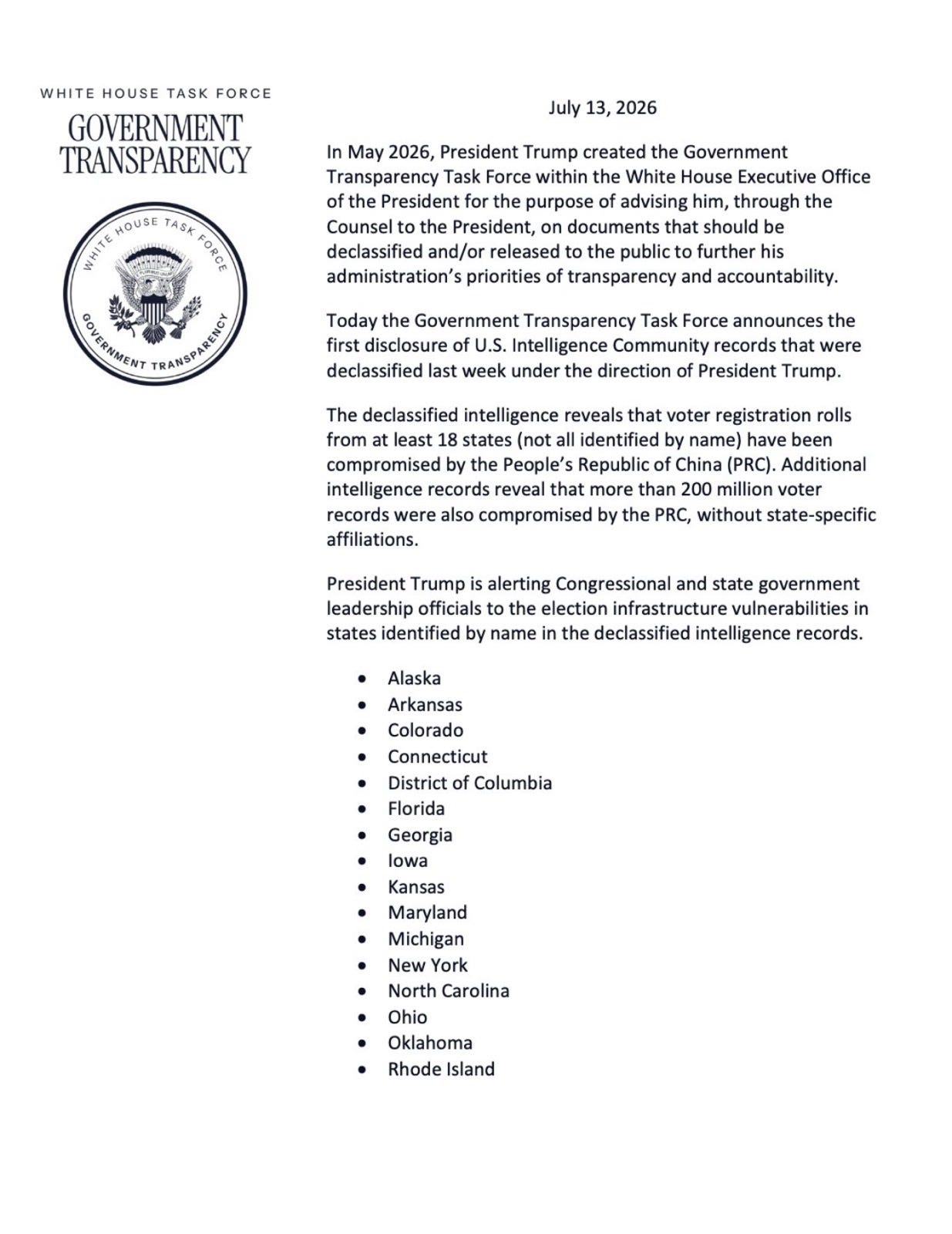
These documented capabilities and architectural vulnerabilities map onto systems New York uses today. The purpose of this analysis is to identify structural and implementation exposures while carefully distinguishing capability from demonstrated successful alteration of results.
New York’s Decentralized Model
New York operates one of the most decentralized election administration models in the country: 62 county Boards of Elections with varying levels of cybersecurity resilience, chain-of-custody discipline, and technological infrastructure. Local control has genuine virtues — including resilience against single-point failure — but it also creates a fragmented attack surface and an inconsistent security baseline. That structural feature is precisely the condition highlighted as concerning in the declassified record.
Current Strengths of New York’s System
New York already maintains meaningful safeguards that reduce the practical risk of large-scale undetected manipulation:
• Voting machines are required by Election Law § 7-202 to produce or retain a voter-verified permanent paper record.
• Machines are prohibited from connecting to the internet or using wireless transmission.
• A post-election audit of voter-verifiable audit records from three percent of voting machines or systems is required under Election Law § 9-211.
• The State Board of Elections conducts pre-use testing of machines, and voter registration systems undergo functional and security testing.
• County systems feed the statewide NYSVoter database under 9 NYCRR Part 6217, with synchronization and shared security responsibilities defined in regulation.
These measures provide a real foundation. Paper records combined with even limited audits make large-scale, undetected electronic alteration significantly more difficult. The gaps identified below therefore concern uneven implementation, residual architectural risk, and eligibility verification rather than the complete absence of safeguards.
Cybersecurity Practices and Infrastructure Gaps
CISA reports from 2019–2024 document that many state, local, tribal, and territorial election offices lack basic fundamental cybersecurity practices. Systems are often accessible from general enterprise networks, with weak identity management, limited logging, and insufficient segmentation. (See CISA’s Election Security Resource Library: cisa.gov/topics/election-security.)
New York’s decentralized county Board of Elections system faces analogous network-segmentation and logging challenges in practice. Limited financial resources in many counties compound the problem: smaller or less affluent counties frequently lack funding to implement and maintain modern secure infrastructure at the same level, creating uneven defenses that adversaries could target at the weakest links. These conclusions are inferred from national patterns and the structural features of New York’s system. Absent detailed, publicly released county-level cybersecurity assessments or FOIL-derived incident data, the conclusions about uneven defenses across the 62 boards remain structural rather than case-specific. Comprehensive public assessments would strengthen the evidentiary base.
Voter Registration and Database Vulnerabilities
NICM assessments identified centralized voter registration databases, pollbooks, and official election websites as the most vulnerable components. Adversaries could exploit them to alter data or disrupt processes. New York maintains large voter rolls across counties and relies on the statewide NYSVoter system. Under 9 NYCRR § 6217.4, county systems must synchronize with NYSVoter at least every 24 hours; security responsibilities are shared between the State Board and county boards (9 NYCRR § 6217.11). These regulatory requirements exist and include security testing. Questions remain about the practical consistency of encryption standards, audit trails, and real-world implementation across all 62 counties.
Separately, New York does not currently require documentary proof of citizenship for registration in most cases, relying primarily on attestation. Photo identification is not required for voters at the polls. These eligibility-verification practices are distinct from pure cybersecurity issues but form part of the broader integrity framework.
Election Management Systems
While public attention often focuses on voting machines themselves, election management systems perform many of the administrative functions that configure an election, including ballot programming, election definition management, and tabulation. These systems therefore represent a critical component of election infrastructure. New York requires certification and pre-election testing of these systems, but—as with other elements of its decentralized county-based model—their secure operation depends upon consistent implementation of cybersecurity practices, access controls, software management, and independent verification across all 62 county Boards of Elections.
Electronic Systems and the Importance of Paper Records
Electronic voting and tabulation systems carry theoretical manipulation risks. Paper records combined with strong post-election audits make large-scale undetected manipulation significantly more difficult — a point reinforced by the declassified materials and by longstanding election-security literature.
ES&S serves as a primary vendor in many counties (including New York City, Albany, Erie, Monroe, Rockland, Schenectady, Suffolk, and others) and has received recent certifications (including EVS 6.5.2.1 components in 2026). Other systems such as Dominion and Clear Ballot (ClearVote) are also certified and in use, with some counties transitioning. Election Law § 7-202 requires a voter-verified permanent paper record, but the overall system still depends heavily on electronic tabulation in many jurisdictions. The residual risk therefore lies in the gap between the paper-record requirement and the depth and independence of the audits that check those records before certification. (Full text of § 7-202: nysenate.gov/legislation/laws/ELN/7-202.)
Foreign Cyber Threats, Supply Chain, and Analytic Standards
CIA reporting detailed Chinese state-sponsored actors targeting campaigns and election-related entities for intelligence collection and network mapping. New York county Board of Elections networks, campaign systems, and election vendors form part of the same attack surface. Any cybersecurity weaknesses increase the feasibility of foreign cyber operations affecting voter data, ballot design, or results transmission. Supply-chain risk assessments for election technology remain uneven across jurisdictions.
The declassified materials, along with internal emails and FBI commentary included in the July 16 release, also illustrate internal debates over how to characterize and label foreign activities across different time periods and products. These debates are visible in the primary documents and have been noted in subsequent independent reviews. Incomplete or contested analytic pictures can complicate prioritization of reforms at the state and county level.
Conclusion
The declassified intelligence materials released on July 16, 2026, do not conclude that foreign actors successfully altered vote totals or changed the outcome of the 2020 election. They do, however, document the capabilities of foreign adversaries, vulnerabilities within election infrastructure, and the importance of strengthening systems against future threats.
New York has some safeguards in place, including voter-verifiable paper records, pre-election testing, and post-election audits. At the same time, its decentralized election administration and varying county resources create challenges that warrant continued attention. The intelligence record underscores that election security is strengthened through layered protections, transparency, independent verification, and continual improvement.
Part 2 of this analysis, coming soon, will examine how the risks identified in the declassified materials compare with the Election Integrity Network’s Model Election Laws Handbook and explore practical administrative and legislative reforms that could further strengthen New York’s election system.
Limitations: This analysis is constrained by the heavy redactions in the declassified set and by the absence of comprehensive public audits of individual New York county election networks. Further FOIL requests and independent technical assessments would allow more granular risk scoring.
“Paper records combined with strong post-election audits make large-scale undetected manipulation significantly more difficult — a point reinforced by the declassified materials and by longstanding election-security literature.”
This is one of the biggest issues. Why do we even use electronic counting at all?, If you ask me it’s suspicious. If hand counting is a method for reliably auditing election counts, why not count that way to begin with? We can still audit by the same method. Correct?
Add to that everything I have read says that the machines are more vulnerable to being manipulated.
And I know a big hurdle with hand counting paper ballots is manpower along with training but I wonder if starting smaller on a trial basis is possible?
Just some thoughts.
Article is very informative. Thanks Bryan.