

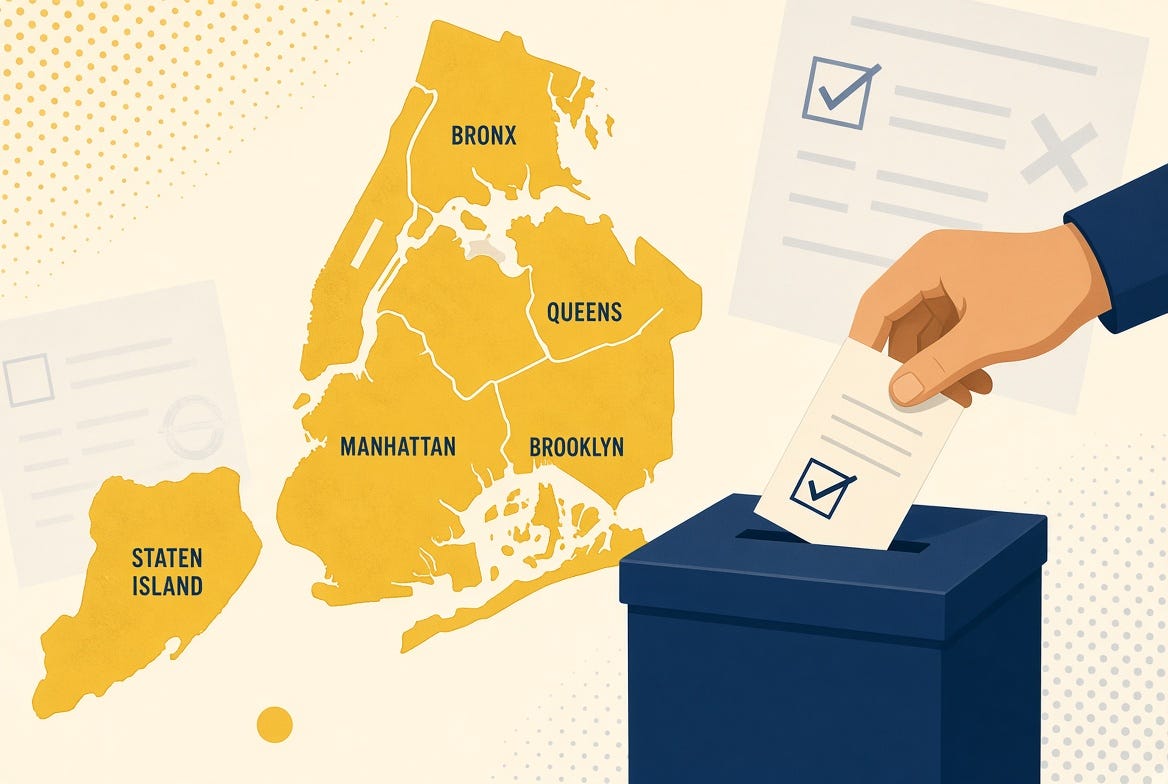
What NYC’s Charter proposals mean for transparency, accountability, and residents’ voice in government.
When you vote this November, remember to turn over your ballot.
New York City voters will decide five proposed amendments to the City Charter—the document that establishes the structure, powers, and operating rules of city government. The questions address public space, government contracts, streets, city property, construction permits, and financial reserves.
Project CIVICA does not support these proposals. Our review centers on four connected priorities: citizen education, meaningful participation, transparency, and accountability.
Residents need clear explanations, timely notice, and opportunities to question decisions before they become final. Public hearings, elected oversight, and scrutiny of government contracting and spending help keep government answerable to the people it serves.
Several proposals would remove required hearings or reduce review by elected representatives. Others raise questions about delegated agency authority and fiscal priorities. Government efficiency should be evaluated alongside these safeguards.
A blank is not a NO
If you oppose a proposal, mark NO. Leaving it blank does not register opposition.
Each question is decided by the majority voting on that question—not everyone who casts a ballot. There is no minimum turnout requirement.
Suppose 1,000 people cast ballots, but only 400 answer a particular proposal. If 210 vote YES and 190 vote NO, it passes. The 600 unanswered questions do not count as NO votes.
Read every question. Vote YES or NO on each one.
At Project CIVICA’s October 22 statewide meeting, Joe Concannon, chairman of the Queens Village Republican Club, briefly explained his objections and urged NYC residents to vote NO on all five proposals.
His central message was straightforward: decisions affecting neighborhoods should involve the people who live there. The accompanying meeting video includes his personal remarks and our discussion of how these proposals reached the ballot.
The five questions: What would change?
These summaries draw from the official NYC Votes explanations. We distinguish the proposed changes from the concerns raised about them.
Voters are deciding changes to the Charter itself. If approved, some implementation details would be developed afterward by city agencies, making continued public oversight important after passage.
Proposal 1: Public-space permissions
Official heading: “Speed Up Process for Granting a Revocable Consent to Use Public Spaces”
The proposal would make required hearings optional for permission—called “revocable consent”—to use public space for features such as ramps, planters, and sidewalk cafés.
Community Boards, Council members, and Borough Presidents would still receive notice and could comment. The City Council would lose its authority to reject sidewalk-café permits through this review process.
Our concern: A guaranteed public hearing would become discretionary, and an existing layer of elected oversight would disappear. Receiving notice and submitting comments do not provide the same influence as a required hearing or the authority to reject an application.
Proposal 2: Government contracting
Official heading: “Reduce City Contractor Paperwork: Require Regular Meetings of Procurement Policy Board”
The proposal would allow changes to contractor questionnaires, require quarterly Procurement Policy Board meetings, and expand delegation of certain contract approvals.
It would also eliminate the required hearing on agencies’ draft annual plans for direct-service contracts, including shelters, job training, and youth programs. Final plans would still be published.
Our concern: Simplifying paperwork can help contractors, but removing a hearing reduces a formal opportunity for residents to question service plans and public spending while changes are still possible. Transparency requires more than publishing a final decision.
Proposal 3: Streets, city property, and office leasing
Official heading: “Speed Up Street Safety Projects, Disposition of Unused City Property, Office Leasing”
This question combines three subjects:
Street projects: In limited urgent safety cases, DOT could begin work before notifying local officials and Community Boards. Technical errors or missed consultations would not justify stopping a project.
City property: Certain transactions could receive expedited review, with Community Boards and Borough Presidents reviewing concurrently and the City Planning Commission making the final decision, without final Council review.
Office space: Required hearings and City Planning Commission and Council approvals for acquiring city workforce office space would be replaced by agency certification and notices.
Our concern: These changes reduce formal review before decisions become final. Combining three subjects also requires voters to accept or reject them as one package, even if they support one provision and oppose another.
When authority shifts toward agencies, residents should understand what independent review remains and who can intervene.
Proposal 4: Building and waterfront permitting
Official heading: “Simplify Building Permitting and Move Waterfront Permitting to Department of Buildings”
The proposal would create a centralized construction-permitting system, allow additional Department of Buildings officials to approve construction documents, and transfer certain waterfront-permitting responsibilities from Small Business Services to the Department of Buildings.
Concern raised in our meeting: Concannon opposed what he viewed as a move toward development shortcuts. Expanding delegated approval authority raises questions about responsibility, review standards, and accountability.
The proposal concerns permitting administration. It does not give developers unrestricted permission to build or itself eliminate existing zoning requirements.
The accountability question is how residents will know who approved a project, what standards were applied, and how errors or complaints will be addressed.
Proposal 5: Financial reserves
Official heading: “Set Contribution Targets for Rainy Day Fund to Promote Sufficient Budgetary Reserves”
The proposal would establish a reserve target of at least 12 percent of the previous year’s city tax revenue, counting the Rainy Day Fund or other fund reserves. It would require a published methodology for contributions.
Deposits would remain subject to the normal budget process. They could occur over several years or be skipped during financial hardship.
Our concern: The proposal sets a savings goal without strong enough rules to ensure the money will be there when needed. The Citizens Budget Commission recommends voting NO for three main reasons:
Saving is not adequately required when revenues are strong. Requiring a contribution plan does not guarantee sufficient deposits.
Money reserved for other purposes can count toward the target. The headline figure may overstate how much is available for a recession.
Withdrawal rules leave too much discretion. CBC argues that withdrawals should be restricted to clearly defined recessions and severe emergencies.
Project CIVICA supports responsible emergency savings. Accountability requires clear rules governing when money must be saved, which funds count, and when officials may spend it.
Voting NO keeps the existing Rainy Day Fund in place. Stronger safeguards would still require further government action.
Transparency, accountability, and the public’s voice
Notice, consultation, hearings, and approval are different things.
Notice tells residents that a decision is being considered.
Consultation allows views to be offered.
A public hearing provides a formal opportunity to present concerns on the record.
Approval authority determines who can accept or reject a proposal.
Community Boards generally serve an advisory role; their recommendations should not be confused with a binding veto. Nevertheless, their review provides a formal channel for neighborhood concerns.
A process can retain public comments while removing a hearing or an elected representative’s authority to intervene. When a proposal promises to preserve “community input,” ask: What influence would residents actually retain?
Transparency means residents can understand what government proposes, why it is being considered, and how to respond. Accountability means knowing who makes the decision, who reviews it, and what happens when concerns are ignored or promises are not met.
Citizen education makes those processes understandable. Participation allows residents to use them.
Together, these principles provide practical questions for evaluating the proposals:
What information will remain public? Who must listen? Who can change or reject a decision? Who answers for the result?
How did these questions reach the ballot?
Mayor Zohran Mamdani convened the Commission on Government Efficiency, or COGE, in May 2026. The commission held ten public hearings and unanimously approved its final report and proposals on July 23.
Under Municipal Home Rule Law § 36, a mayor can appoint a Charter Revision Commission of nine to fifteen city residents. The commission must hold public hearings and can submit proposals directly to voters without first obtaining City Council approval.
The mayor does not have to collect petition signatures or win a preliminary public vote to create the commission.
The commission must follow the required procedures, but it does not have to demonstrate support from a minimum number of residents before submitting its proposals.
Residents seeking to establish a commission through a citizen petition face additional hurdles: collecting thousands of valid signatures and then winning a public vote to create it. Any Charter changes that commission later proposes must also go to voters.
City officials have an institutional route for initiating changes. Residents acting independently must first demonstrate substantial organized support.
The commission and public hearings explain the process. They do not establish that the resulting proposals deserve approval.
The mayor appoints the commission. The commission selects its proposals. Voters decide whether to adopt them.
How residents can bring their own ideas to a vote
New York has no general statewide citizen-initiative process, but state law provides city residents with petition routes for Charter changes.
Two important routes are proposing a specific amendment and seeking the creation of a Charter Revision Commission.
Propose a specific Charter amendment
Under Municipal Home Rule Law § 37:
The initial petition requires qualified signatures equal to 10 percent of the city’s last gubernatorial vote, or 30,000, whichever is less.
The petition must contain the full proposed local law and be filed with the City Clerk.
The Council can act on the proposal. Its ability to adopt it directly depends on whether a mandatory referendum is required.
If the Council does not adopt or submit it unchanged within two months, a second qualifying petition can require submission to voters.
The second petition requires 5 percent of the last gubernatorial vote, or 15,000, whichever is less, from qualified people who did not sign the first.
It must be filed between two and four months after the original filing, with the general election at least sixty days after the second filing.
Petition to create a Charter Revision Commission
Section 36(3) provides another route: petition for a public vote on creating a commission.
The threshold is 15 percent of the city’s last gubernatorial vote, or 45,000, whichever is less. The proposed law sets the commission’s composition and selection arrangements. If voters approve its creation, the commission can develop changes for a later vote.
Both routes require careful drafting, valid signatures, and compliance with deadlines. Proposed changes must also fall within the city’s lawful authority.
More signatures than a gubernatorial primary petition?
Stephen Scher highlighted a striking comparison during our meeting.
A petition to create a city Charter Revision Commission can require 45,000 valid signatures. A candidate petitioning onto a party’s statewide gubernatorial primary ballot faces a threshold of 15,000 signatures, or 5 percent of eligible enrolled party voters, whichever is less, along with geographic distribution requirements.
At those numerical thresholds, residents seeking a commission must collect three times as many signatures, within New York City, as a gubernatorial primary candidate collecting statewide.
The rules differ. An independent gubernatorial nominating petition has a threshold of 45,000 signatures, or 1 percent of the last statewide gubernatorial vote, whichever is less, plus geographic requirements. The comparison therefore applies specifically to the party-primary petition route.
It illustrates the substantial organizational burden residents face when initiating changes themselves.
State law creates another obstacle: a qualifying § 37 proposal that would otherwise appear alongside Charter commission questions is deferred to the following year’s general election.
Residents have tools to propose change. Using them requires organization, resources, and sustained participation.
If proposals pass, oversight must continue
If approved, some implementation details would be developed afterward by city agencies. Residents should continue following proposed rules, public notices, contracting plans, and budget decisions.
Ask who holds decision-making authority, what information will be published, and how public concerns will be addressed. Use the public comment opportunities that remain and ask elected representatives to scrutinize implementation.
The NYC Rules website provides a place to follow proposed agency rules and available comment opportunities.
Public accountability requires informed participation before the vote and continued oversight afterward.
Know your ballot before you vote
Visit your local Board of Elections website and review your sample ballot. Become familiar with the offices up for election, the candidates, and any proposals you will be asked to decide.
These five Charter questions apply to New York City voters. Voters elsewhere should check for proposals specific to their own communities.
Read the questions before entering the polling place so you have time to understand them and seek answers. Ask a poll worker for help locating the proposals if necessary.
Early voting runs October 24–November 1. Election Day is November 3.
Share this article with others preparing to vote.
Project CIVICA educates residents, encourages civic participation, and advocates for transparent, accountable government. Our review of these proposals reflects those priorities: understandable decisions, meaningful public review, responsible spending, and officials who remain answerable to the communities they serve.
Check both sides of your ballot. Vote YES or NO on every proposal. If you oppose a proposal, mark NO—leaving it blank does not register opposition.
Sources and further reading
NYC Votes: Official explanations of all five proposals
COGE: Public hearings and recordings
NYC Community Boards: Responsibilities and advisory role
Election Law § 6-136: Party designating petitions
Election Law § 6-142: Independent nominating petitions
NYC Rules: Proposed agency rules and public comment opportunities
Project CIVICA statewide meeting, October 22, 2026.