

Every month, Project Civica analyzes New York’s statewide voter registration list to better understand how voter records change over time and how New York administers its voter rolls.
In June, we examined the process for identifying and removing deceased voters. In July, we looked at what happens when a New York voter moves out of state.
This month, we turn to another important component of voter-list maintenance: duplicate voter registrations.
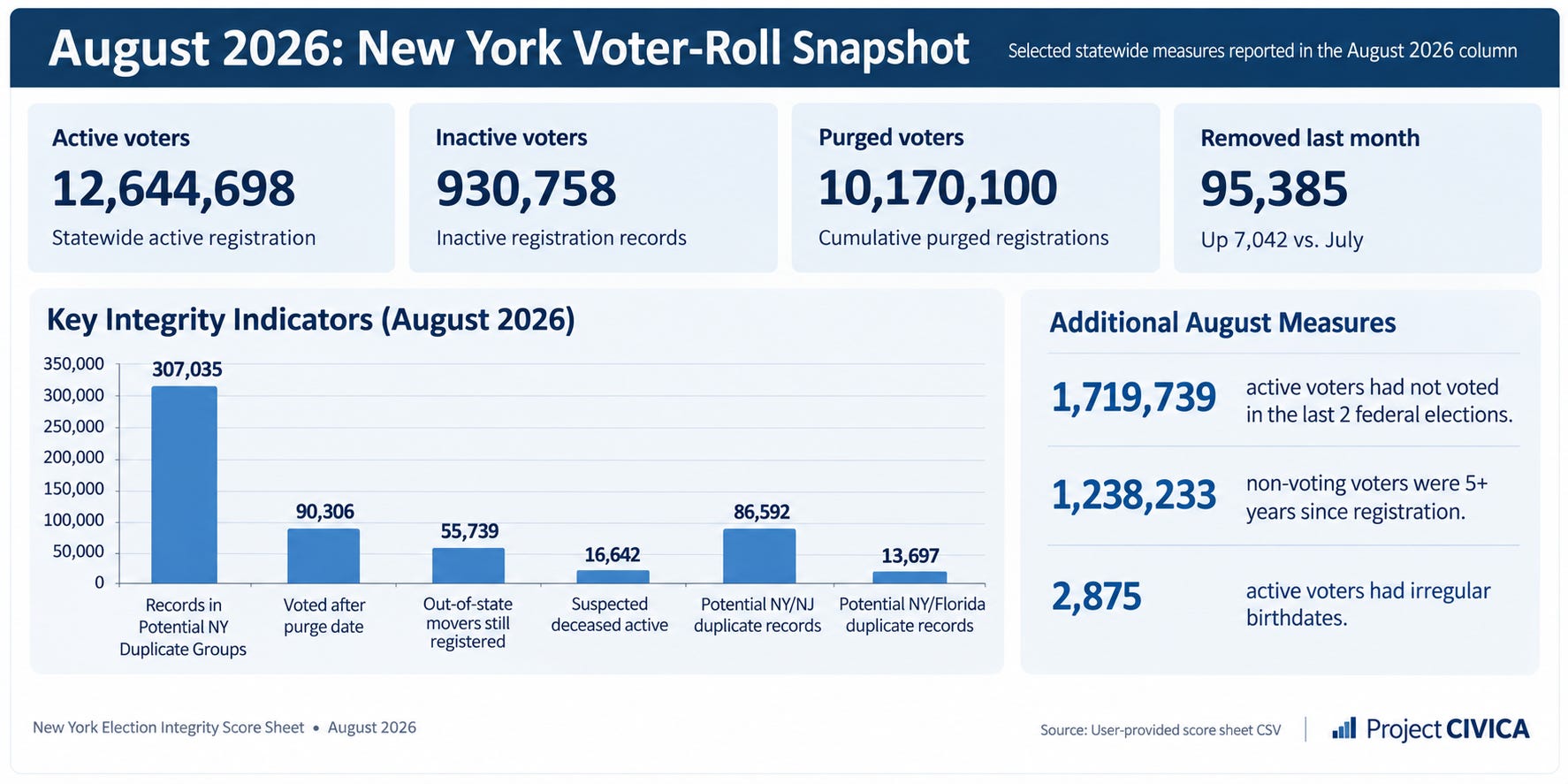
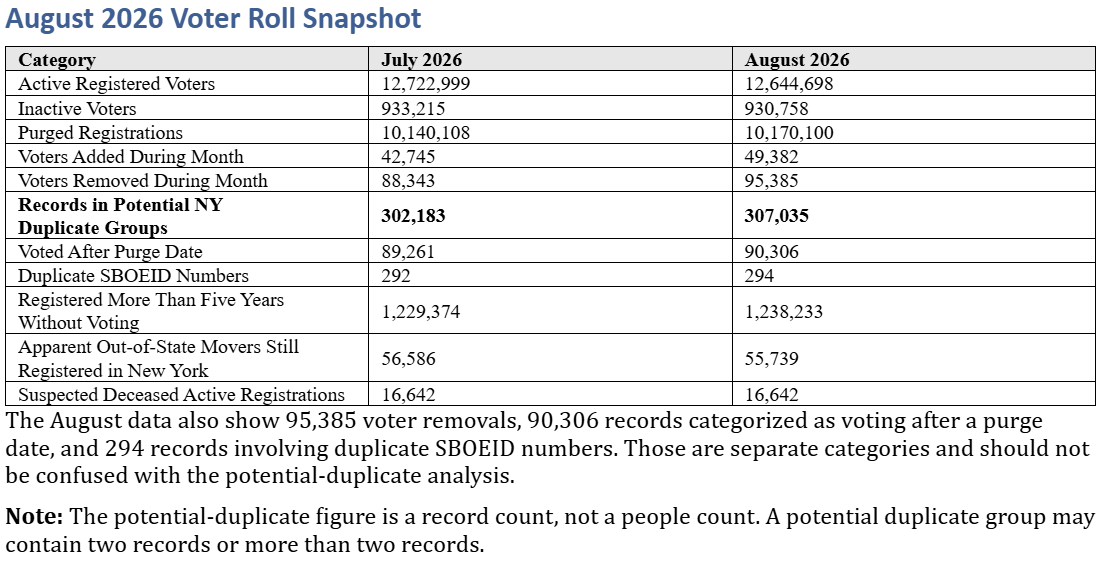
Project Civica’s August 2026 analysis identified 307,035 voter-registration records linked within potential duplicate groups, compared with 302,183 in July—an increase of 4,852 records, or approximately 1.6%.
That number needs to be understood carefully. It does not mean that 307,035 people are illegally registered more than once. It does not mean that 307,035 people voted twice. And it does not mean that every record identified by our analysis will ultimately be determined to be a duplicate.
It means that Project Civica identified 307,035 voter-registration records linked to one or more other records based upon similarities that warrant further investigation.
New York itself recognizes that duplicate detection cannot be limited to perfectly identical records. NYSBOE’s system requirements call for duplicate searches involving phonetic, transposition and like-spelling matches, in addition to the near-real-time duplicate matching required under New York’s voter-database regulations.
The question is therefore not simply whether potential duplicates exist. How is New York supposed to identify, investigate and resolve them—and how well is that process working?
About This Analysis
Project Civica independently analyzes New York’s statewide voter registration list using point-in-time snapshots obtained through New York’s Freedom of Information Law (FOIL).
Because the statewide voter registration database is continually updated, these snapshots preserve the voter rolls as they existed on a particular date, allowing meaningful month-to-month comparisons.
For duplicate analysis, Project Civica developed matching criteria intended to approximate the types of duplicate-registration checks New York’s own statewide system is supposed to perform.
Our analysis examines names, dates of birth, addresses and other identifying information. When records meet one of our potential-match criteria, the corresponding records are linked together, allowing a reviewer to see the records and the information that caused them to be flagged.
The findings identify records requiring further review. They do not, by themselves, establish illegal registration, illegal voting or a violation of election law.
What Is a Potential Duplicate?
At its simplest, a potential duplicate exists when two or more voter-registration records contain enough corresponding information to indicate that they may belong to the same individual.
But duplicate records are not necessarily identical. A voter may move and submit another registration application. A person may change a last name. A first and middle name may be reversed. A date of birth may be entered incorrectly. The month and day may be transposed. A name may be abbreviated, misspelled or entered differently on separate records.
And sometimes two different people simply have similar identifying information.
That is why potential duplicate is an important distinction. A potential duplicate is a record requiring investigation. It is not a conclusion that the same person is improperly registered twice.
How Project Civica Identifies Potential Duplicates
Project Civica’s duplicate analysis was designed to approximate the types of duplicate-registration checks New York’s statewide voter-registration system is supposed to perform.
The analysis looks for multiple types of relationships between records, including:
identical records;
near-identical records;
identical or near-identical names;
similar names;
possible name changes;
transposed first and middle names;
transposed month and day in dates of birth;
address and move-related matches; and
similar names and identifying information within the same household.
Other identifying information contained in the voter records is available to assist in reviewing the match.
Importantly, Project Civica does not simply generate a list of individual records labeled “duplicates.” Potentially related records are linked together.
A reviewer can see the primary record, the pertinent identifying information and ID numbers, the reason the record was flagged, and the corresponding record or records to which it was matched.
Some potential duplicate groups contain two records. Others contain three or more.
That allows the reviewer to investigate the relationship between the records rather than relying solely upon an automated determination.
And every match requires investigation. A review may establish that the records belong to the same voter. It may reveal a legitimate move or name change. It may identify a data-entry or administrative problem. Or it may establish that two similar records actually belong to different people.
A match is the beginning of the investigation—not the conclusion.
Know the Law
Federal law, New York Election Law and New York’s statewide voter-database regulations all address duplicate voter registrations.
Help America Vote Act (52 U.S.C. § 21083)
The Help America Vote Act (HAVA) requires New York to maintain a single, uniform, official, centralized and interactive computerized statewide voter-registration list.
HAVA also requires a unique identifier for each legally registered voter and regular list maintenance designed to ensure that eligible registered voters remain on the list while duplicate names are eliminated.
New York’s statewide voter-registration system is known as NYSVoter.
New York regulations state that NYSVoter is the state’s single interactive statewide voter-registration list and is to maintain one record for each registered voter, including the voter’s statewide unique identifier, status, voter history, previous names and previous addresses.
New York State Regulations (9 NYCRR § 6217.8)
New York has a regulation specifically titled “Processing duplicate voters.”
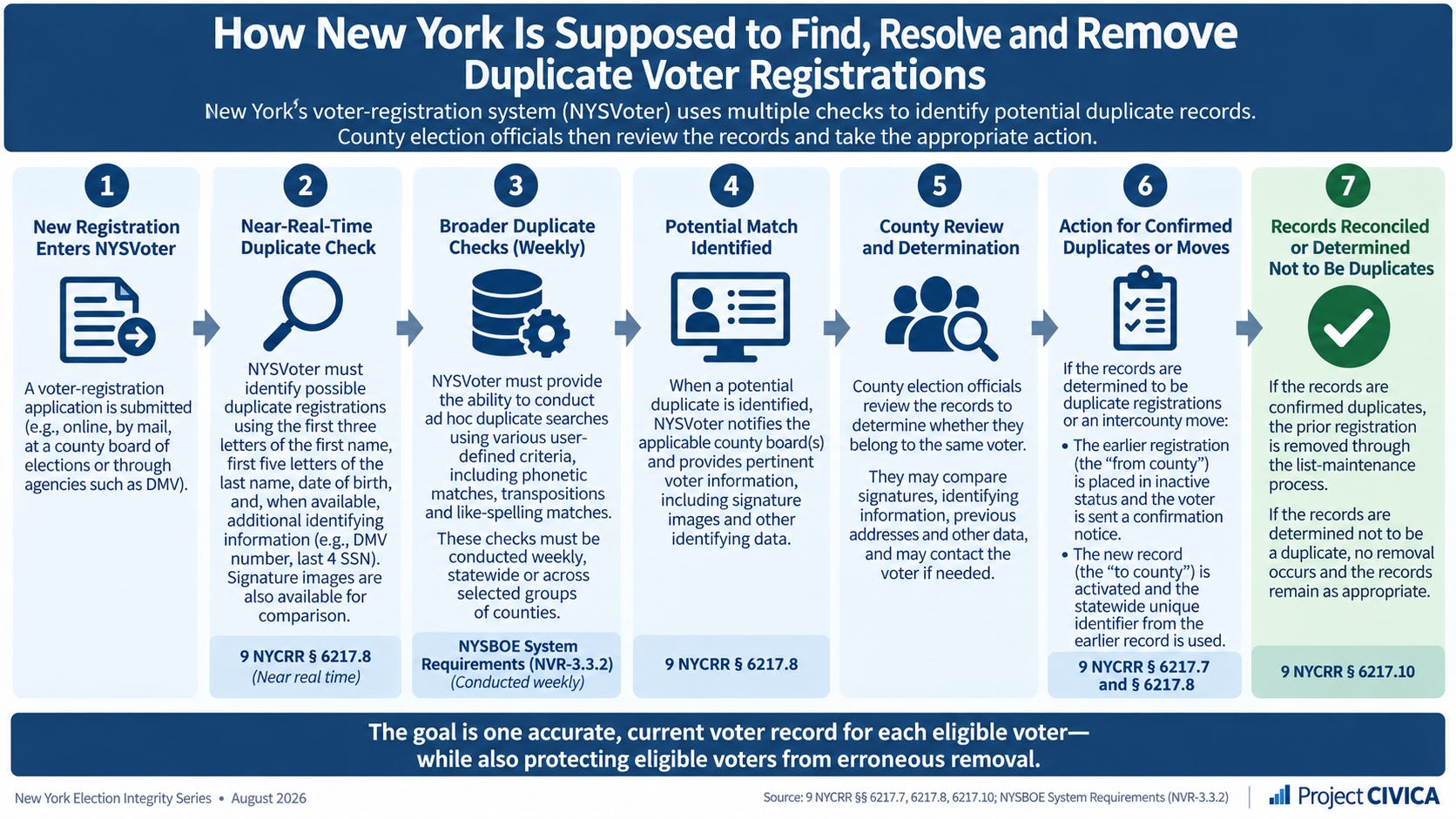
Under 9 NYCRR § 6217.8, NYSVoter must identify possible duplicate registrations.
For one type of duplicate search, the regulation provides for matching an applicant’s first name, last name and date of birth.
For registration application transactions, NYSVoter must perform possible-duplicate matching “in near real time” using the first three letters of the first name, first five letters of the last name, date of birth and, when available, additional identification information such as the statewide unique identifier, DMV number or last four digits of the Social Security number.
The potential duplicate voter’s signature image is also made available to county boards for comparison.
So New York is not supposed to wait months or years before first looking for an obvious potential duplicate generated by a new registration transaction. The regulation requires that matching to occur at or near the time the transaction enters the system.
New York Is Also Supposed to Conduct Broader Duplicate Searches
The near-real-time check is not the entire process.
NYSBOE’s voter-registration system requirements provide for ad hoc duplicate checks using a variety of user-defined criteria, specifically including phonetic matches, transpositions and like-spelling matches.
Those searches can be conducted statewide or across selected groups of counties. The system requirement states that such checks must be conducted weekly.
This distinction is important. The near-real-time duplicate matching comes from New York’s statewide voter-database regulation, 9 NYCRR § 6217.8. The requirement for the broader phonetic, transposition and like-spelling checks to be conducted weekly appears in NYSBOE’s NYSVoter system requirements.
Together, they demonstrate that New York’s duplicate-detection process is not supposed to be limited to finding two records that are perfectly identical.
That is also why Project Civica’s analysis looks for variations such as similar names, transpositions and other relationships between records rather than limiting the analysis to exact matches.
Project Civica does not have access to NYSVoter’s internal matching algorithms or all of the information available to election officials, so our methodology should not be viewed as a replication of NYSVoter. But the objective is similar: identify records that may belong to the same voter so that they can be investigated and properly reconciled.
What Happens When New York Finds a Possible Duplicate?
Identifying the records is only the first step.
Under New York State Regulations (9 NYCRR § 6217.8), when NYSVoter identifies potential duplicate registrations between counties, the system must notify the counties containing the matching records and provide pertinent information about the voter.
If the information indicates that a voter is currently registered more than once, the county containing the earlier registration, the “from county”must send the voter a confirmation notice and place that registration into inactive status.
After officials determine that the voter is actually a duplicate, the “to county” activates the new record and substitutes the statewide unique identifier from the earlier record.
This distinction matters: NYSVoter identifies a possible duplicate. Election officials must determine whether the records actually belong to the same voter.
When the “Duplicate” Is Really a Move
Some potential duplicates are likely to be the result of an ordinary move.
A voter registered in Erie County, for example, may move to Monroe County and submit another voter-registration application.
New York State Election Law (§ 5-208) specifically provides for transferring the registration of a voter who changes address within New York. The statute expressly recognizes an application for registration from a person already registered in New York State as one form of notice that can initiate an address transfer.
New York’s regulations also require NYSVoter to identify apparent duplicate records that may represent moves between counties based on name and date of birth. Counties can then verify the move using signatures and additional identifying information or the voter’s previous address.
So the existence of two related voter records does not, by itself, indicate wrongdoing. It may indicate that a voter moved and the records need to be transferred and reconciled.
New York Requires Duplicate Registrations to Be Reconciled
New York’s broader list-maintenance regulation is explicit about the objective.
Under New York State Regulations (9 NYCRR § 6217.10), statewide list maintenance must be conducted so that eligible registered voters remain on the statewide list; only people who are not registered or not eligible are removed; and prior registrations of duplicate names are removed.
The regulation also requires a county to search existing voter records before treating an application as a new registration when the application may actually represent an update to an existing record.
The goal is therefore not simply to find duplicates. The goal is to identify them accurately, investigate them, preserve the eligible voter’s correct registration and reconcile the prior record.
What Happens to the Prior Registration?
New York’s regulations provide additional detail about what should ultimately happen to the earlier registration after duplicate records are reconciled. Under 9 NYCRR § 6217.10, voter-list maintenance must ensure that “prior registrations of duplicate names are removed” from the statewide list. When a county determines that a registration is to be canceled, the regulation requires the record to be placed in Purged status with the appropriate reason code.
Importantly, “purged” does not mean the historical record is erased. New York Election Law § 5-404 requires cancellation to be recorded without obliterating the existing entries, preserving the reason for cancellation in the voter record.
This creates an important additional question about the duplicate-resolution process. 9 NYCRR § 6217.8 provides for the earlier registration to be placed in Inactive status while a potential duplicate is resolved, and for the original statewide voter identifier (SBOEID) to be carried forward to the voter’s current registration once the duplicate is determined. However, we have not identified a specific statutory or regulatory deadline requiring the prior Inactive record to be moved to Purged status after that reconciliation is completed.
That distinction matters. An older Inactive record may simply reflect a duplicate that is still being reviewed. But where the newer Active registration already carries the original SBOEID, it raises a different question: Has the duplicate already been resolved, and if so, when should the prior Inactive registration be purged?
What Project Civica Found
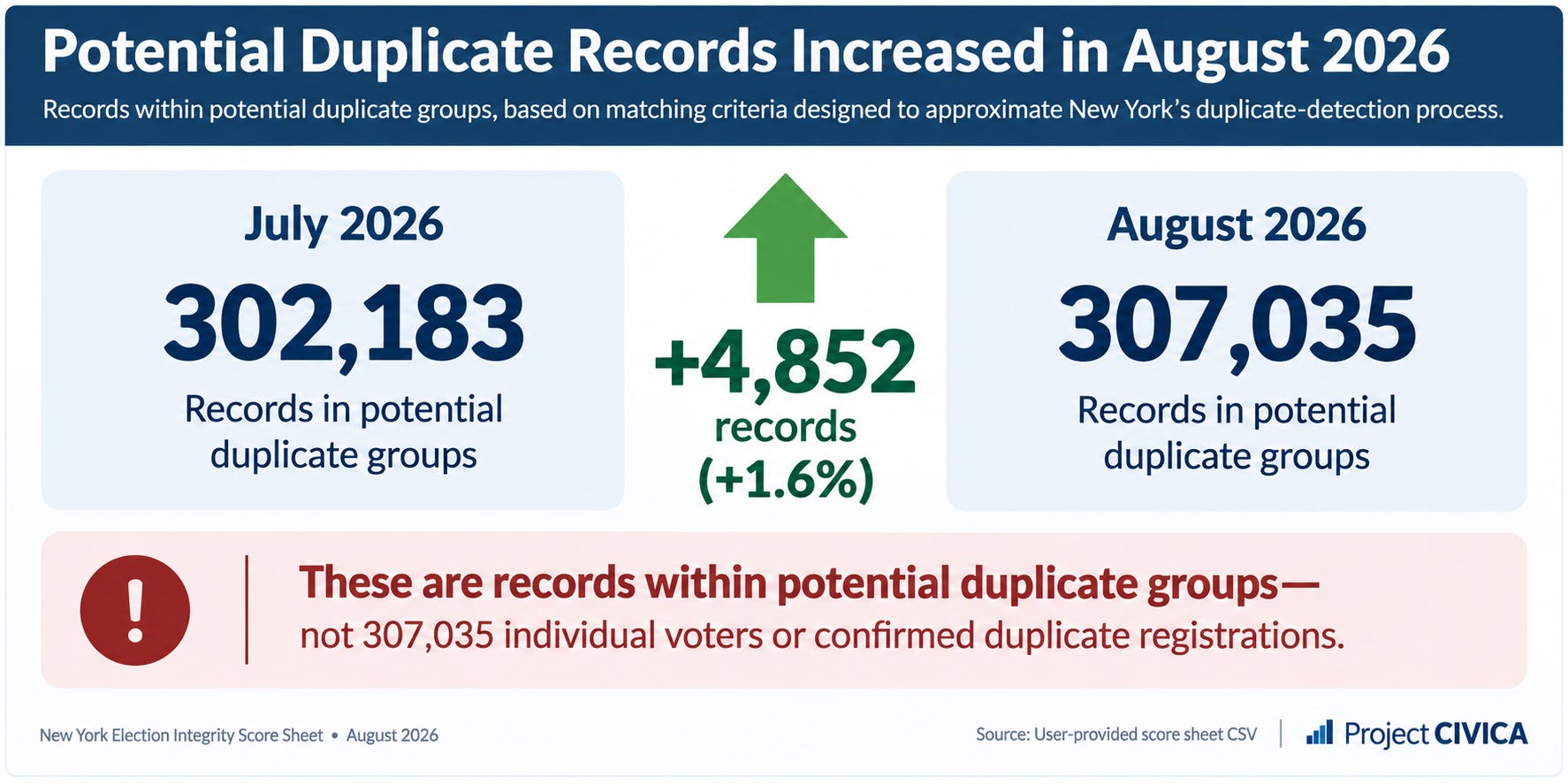
In August 2026, Project Civica identified 307,035 voter-registration records linked within potential duplicate groups.
That was an increase of 4,852 records in one month.
Again, this does not mean that New York has 307,035 people improperly registered more than once.
Some of the records may represent different people. Some may involve legitimate moves or name changes. Some may be newly created potential matches. Some may already be undergoing review or reconciliation.
But New York’s own requirements give us an important benchmark against which to evaluate the finding.
New York requires near-real-time duplicate matching for registration transactions. Its system requirements call for broader phonetic, transposition and like-spelling duplicate checks weekly. And its list-maintenance regulations require prior duplicate registrations ultimately to be removed while protecting eligible voters.
When Project Civica’s independent analysis identifies 307,035 records within potential duplicate groups using criteria intended to approximate New York’s own duplicate-detection process, how many of those records has NYSVoter also identified and where are they in the State’s investigation and reconciliation process?
A Different Problem: Duplicate SBOEID Numbers
There is another category in Project Civica’s analysis that should not be confused with potential duplicate registrations.
In August, Project Civica identified 294 duplicate SBOEID numbers, up from 292 in July.
The SBOEID is the statewide identifier associated with a voter record. That makes this fundamentally different from finding two records with similar names, dates of birth or addresses.
New York’s statewide system was established on the premise that each voter would receive a unique identifier, and the regulations require the identifier to follow the voter when duplicate records are reconciled.
The 294 apparent duplicate SBOEID records therefore warrant separate technical review and explanation.
Why Does It Matter?
Accurate voter-registration records are fundamental to election administration.
Duplicate records can affect voter histories, address information, election-district assignments, poll books and the ability of election officials to maintain an accurate statewide list.
But inaccurate duplicate matching creates a different danger. Two different eligible voters can have similar names, dates of birth or addresses. Removing the wrong record could interfere with an eligible voter’s registration.
That is why investigation matters.
The objective should not be to remove the greatest possible number of records. It should be to maintain one accurate, current voter record for each eligible voter while protecting eligible voters from erroneous removal.
Questions New York Election Officials Should Answer
How many potential duplicate registrations is NYSVoter currently identifying statewide?
Are the broader phonetic, transposition and like-spelling duplicate checks required by NYSBOE’s system requirements being conducted weekly?
How many potential duplicate records are identified through those weekly searches?
How many potential duplicates are identified through the near-real-time registration check?
What specific matching criteria and tolerances does NYSVoter currently use for its broader duplicate searches?
How many potential matches are ultimately determined to involve different people?
How many represent moves, name changes or updates to an existing registration?
How many are confirmed duplicate registrations requiring reconciliation?
How long do potential duplicate records remain unresolved after being identified?
Does NYSBOE maintain reports showing unresolved potential duplicates and how long they have been awaiting resolution?
How does NYSBOE monitor county boards’ investigation and resolution of duplicate notifications?
How many duplicate registrations have been reconciled statewide during the past year?
These questions do not presume misconduct. They ask whether the duplicate-detection and reconciliation system New York has already established is operating as intended.
What You Can Do
Voters can help maintain accurate voter rolls by checking their registration after moving, changing their name or submitting a new voter-registration application.
If you discover what appears to be an old or duplicate registration associated with you, contact your county Board of Elections and ask that the records be reviewed.
Citizens can also ask state and county election officials for greater transparency about the duplicate-registration process—including how many potential duplicates are identified, how quickly they are investigated and how they are ultimately resolved.
Policy Questions
New York already has laws, regulations and system requirements addressing duplicate registrations.
The first question for policymakers may therefore be less about creating another duplicate-detection system and more about measuring and making transparent the performance of the one New York already has.
Should NYSBOE be required to publicly report how many potential duplicates are identified, how many are resolved, how many are determined to be different people, and how many remain unresolved?
Should New York establish and publicly report performance standards for the timely investigation and reconciliation of potential duplicate registrations?
If NYSBOE’s system requirements say broader duplicate checks must be conducted weekly, should the State publicly report the results of those checks and what actions were taken?
Looking Ahead
New York’s voter-registration system is specifically designed to identify possible duplicate registrations.
The regulations require near-real-time matching when registration transactions enter the system. NYSBOE’s system requirements call for broader searches involving phonetic matches, transpositions and like spellings to be conducted weekly. And New York’s list-maintenance regulations require prior duplicate registrations to be reconciled while eligible voters are protected.
Project Civica’s August analysis identified 307,035 voter-registration records linked within potential duplicate groups.
That number is not the end of the analysis. It is where the investigation begins.
The next question is whether New York’s own system is identifying the same records—and, when it does, how quickly and effectively those records are investigated and resolved.
Project Civica will continue analyzing New York’s voter-registration data, comparing changes over time and asking whether the systems established to maintain accurate voter rolls are functioning as required.
Legal Authorities and Sources
Help America Vote Act (52 U.S.C. § 21083)
New York State Election Law (§ 5-208)
New York State Regulations (9 NYCRR § 6217.1) — NYSVoter statewide voter registration list
New York State Regulations (9 NYCRR § 6217.7) — moves between counties
New York State Regulations (9 NYCRR § 6217.8) — Processing duplicate voters
New York State Regulations (9 NYCRR § 6217.10) — statewide list maintenance
NYS Board of Elections voter-registration system requirements — duplicate checks, including phonetic, transposition and like-spelling matching
Excellent work. This type of work helps keep the Boards of Elections on their toes. They have been obviously complacent in the past, maybe less so today, thanks to the efforts of the Project Civica Research Team.