

Project CIVICA | September 2026 Voter Roll Review
Each month, Project CIVICA analyzes New York’s voter-registration records to identify potential inaccuracies, monitor changes, and examine how the state’s voter rolls are maintained.
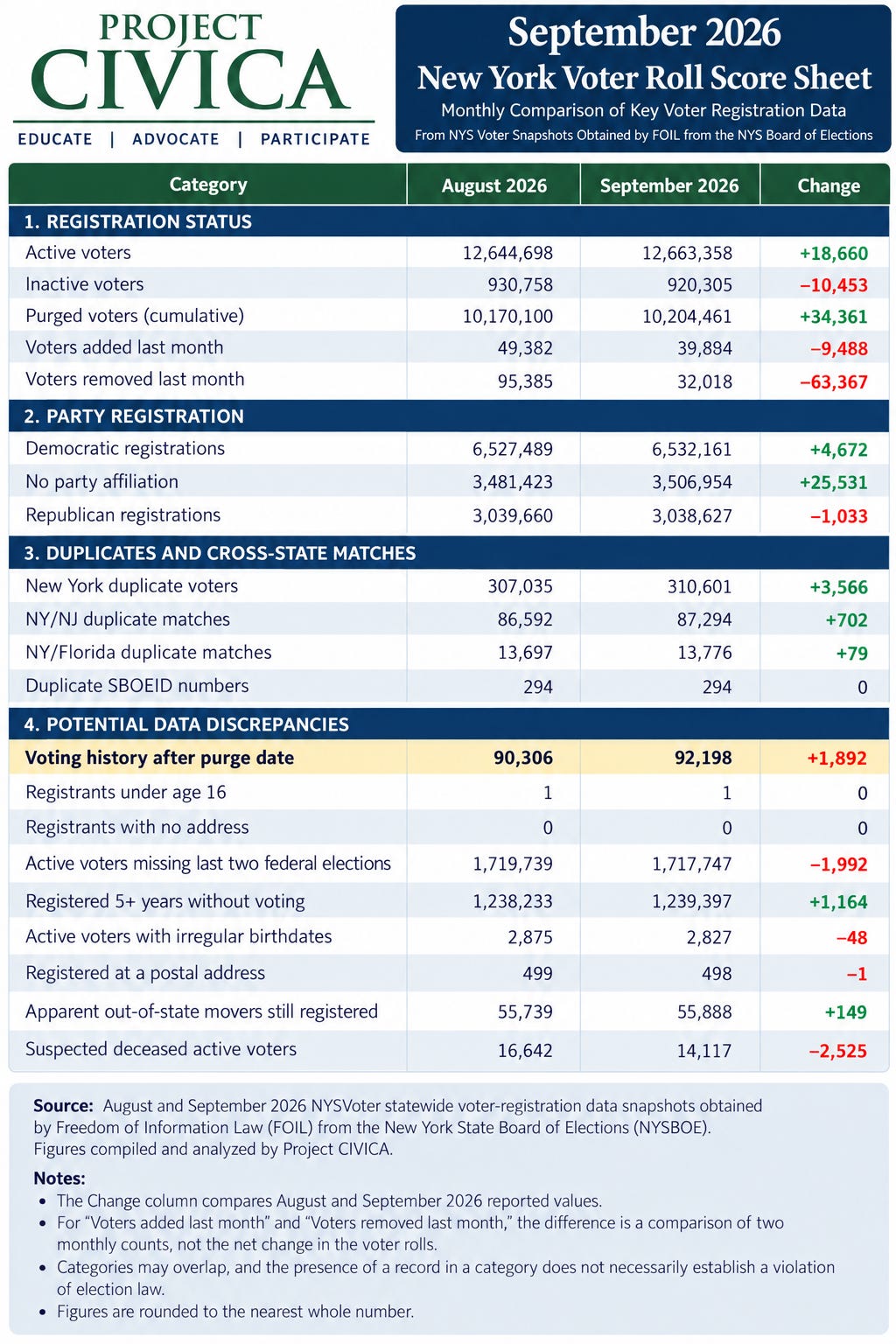
Our September 2026 analysis identified 92,198 voter records containing voting history dated after their recorded purge dates, an increase of 1,892 from August.
This raises an important question: If a voter registration has been canceled, why does the record show voting activity afterward?
Understanding this issue begins with how New York classifies voter registrations, why registrations are canceled, and what state and federal law require.
Understanding Voter Registration Status in New York
New York’s statewide voter-registration system, NYSVoter, uses several classifications to identify the status of voter-registration records.
Active (A)
An individual whose registration is active and who is eligible to vote, provided all other legal qualifications are met.
The statewide database also includes specialized active classifications:
AM: Active Military: Registered voters covered by applicable military voting provisions.
AU: Active UOCAVA: Registered voters covered by the Uniformed and Overseas Citizens Absentee Voting Act.
AF: Active Special Federal: Voters registered under special federal voting provisions.
AP: Active Special Presidential: Voters registered under special presidential-election provisions.
Inactive (I)
An individual who remains registered but whose record has been placed in inactive status, often because election officials have received information suggesting a possible change of address.
Inactive voters remain eligible to vote, subject to applicable legal qualifications and voting procedures. They may need to confirm their address or follow additional procedures when voting.
Purged (P)
A voter-registration record that has been canceled for a legally recognized reason.
A purged registration is no longer valid for voting. However, an otherwise eligible individual may subsequently register again or seek correction of an erroneous cancellation.
Pre-registered
New York permits eligible individuals ages 16 and 17 to pre-register to vote. Pre-registration does not authorize an individual to vote before meeting the applicable voting-age requirement.
What Is a Purge Date?
The purge date is the date recorded in NYSVoter indicating when a voter-registration record was purged, or canceled.
The database also contains a reason code identifying why the registration was canceled, such as death, a change of residence, felony disqualification, voter request, or completion of the NVRA removal process.
The purge date provides an important reference point for reviewing registration history. However, the recorded date does not necessarily establish when the cancellation legally became effective.
When voting history appears after the recorded purge date, the discrepancy warrants further examination.
Possible explanations include an incorrect purge date, subsequent registration activity, or inconsistencies between county and statewide records.
Why Are Voter Registrations Purged?
New York Election Law (§ 5-400) establishes grounds for canceling voter registrations.
These include:
Death: The registered voter has died.
Felony Disqualification: The individual is incarcerated for a felony conviction under circumstances specified in New York Election Law (§ 5-106). A felony conviction alone does not automatically eliminate voting rights.
Change of Residence: The voter has moved outside New York State and the applicable legal requirements for cancellation have been satisfied.
NVRA List Maintenance: The required notice and waiting period have been completed without qualifying voter activity. Failure to vote alone is not grounds for cancellation.
Voter Request: The individual has requested cancellation of their registration.
Non-Citizenship: United States citizenship is required to register and vote in New York. A registration belonging to an individual who does not meet this requirement may be canceled following appropriate verification (Election Law §§ 5-102 and 5-400).
Court-Determined Mental Incompetence: New York law provides for disqualification following a qualifying court determination of legal incompetence (Election Law §§ 5-106(6) and 5-400). A disability, cognitive impairment, dementia, or court-appointed guardian does not automatically eliminate voting rights.
Refusal of a Required Challenge Oath: Refusal to take an oath legally required during a voter challenge may provide grounds for cancellation.
Other Legal Disqualification: Other circumstances in which an individual no longer meets the legal qualifications for voting.
What About Duplicate Registrations?
New York’s voter-registration regulations also require election officials to identify and address duplicate registrations (9 NYCRR §§ 6217.8 and 6217.10).
When duplicate records are identified, prior registrations may need to be removed or consolidated while preserving the individual’s valid registration.
A duplicate record does not necessarily mean the individual is ineligible to vote.
Protecting the Voting Rights of Vulnerable Individuals
The distinction involving court-determined mental incompetence is particularly important for residents of nursing homes and long-term-care facilities.
Living in a care facility does not eliminate a person’s right to vote. Neither does a medical diagnosis, cognitive impairment, or the appointment of a guardian automatically establish voting disqualification.
Through its Vulnerable Voter Project, Project CIVICA works to educate nursing homes, long-term-care facilities, residents, and families about New York’s voting laws and the rights of vulnerable individuals.
Those protections include both the right of an eligible individual to vote and the right to decline to vote, free from improper influence or coercion.
What Does Federal Law Require?
Two federal laws establish important requirements for maintaining accurate voter-registration records.
National Voter Registration Act (NVRA)
Section 8 of the NVRA (52 U.S.C. § 20507) requires states to conduct reasonable, uniform, and nondiscriminatory voter-list maintenance.
The law establishes procedures for removing registrations involving deceased voters and individuals who have changed residence.
For certain residence-related removals, the NVRA requires written confirmation or a prescribed notice process followed by two federal general elections without qualifying voter activity.
Simply failing to vote is not sufficient grounds for removing a registration.
The NVRA also generally requires systematic voter-removal programs to be completed at least 90 days before a federal election, subject to statutory exceptions.
Help America Vote Act (HAVA)
Section 303 of HAVA (52 U.S.C. § 21083) requires states to maintain computerized statewide voter-registration lists.
These requirements include regular list maintenance, unique voter identifiers, and coordination with appropriate records concerning deaths and felony disqualifications.
Together, these laws establish requirements intended to maintain accurate registration records while protecting eligible voters against improper removal.
Can Someone Vote After Their Registration Has Been Purged?
A properly canceled registration cannot be used as a valid registration to vote.
However, several circumstances must be distinguished.
An individual whose registration was canceled may subsequently register again. A person whose registration was canceled in error may also have legal remedies.
Under New York law, a voter whose name does not appear in the poll book may be entitled to cast an affidavit ballot. Election officials must determine whether the ballot meets the applicable legal requirements before counting it (Election Law §§ 8-302 and 9-209).
Therefore, voting history appearing after a recorded purge date does not automatically establish that an unlawful vote occurred.
Determining what happened requires examining the registration history, cancellation reason, relevant dates, and any subsequent registration activity.
September 2026: New York Voter Roll Score Sheet
The following table summarizes Project CIVICA’s September 2026 findings and compares them with the previous month’s reported figures.
A Closer Look at County Records
Project CIVICA is conducting additional research at the county level to better understand why certain voter records contain voting history dated after their recorded purge dates.
Our current research focuses on records associated with deceased voters.
By locating publicly available obituaries, researchers can identify reported dates of death and compare them with the purge dates, cancellation reasons, and voting histories recorded in New York’s voter-registration system.
This comparison helps identify records requiring further examination, particularly when the reported date of death, registration cancellation, and voting activity appear inconsistent.
Obituaries provide an independent reference point, although additional documentation may be necessary to confirm an individual’s identity and date of death.

A vote recorded after a purge date is not necessarily a vote recorded after death. These are separate questions that require examination of the underlying records.
The purpose of this research is to determine whether discrepancies reflect inaccurate dates, errors in voter-registration records, or other circumstances requiring clarification, not to presume that an unlawful vote occurred.
Why Accurate Voter Records Matter
When a registration is canceled, the reason for cancellation and the effective date should be accurately documented.
New York Election Law (§ 5-404) addresses the documentation of registration cancellations. State regulations (9 NYCRR § 6217.10) also establish requirements relating to registration records and their maintenance.
Likewise, voting history should accurately reflect when an individual participated in an election and the registration under which that activity occurred.
New York’s county boards of elections and statewide voter-registration system must maintain reliable information to support proper election administration.
Project CIVICA continues to examine these discrepancies and seek clarification through its ongoing voter-roll research.
Our September findings leave an important question unanswered: Why do 92,198 voter records show voting history after their recorded purge dates?
Understanding the answer requires accurate records, clear explanations of registration changes, and consistent application of state and federal election law.
Legal References
New York Election Law §§ 5-102, 5-106, 5-400, 5-402, 5-404, 8-302, and 9-209.
New York State Election Regulations, 9 NYCRR §§ 6217.8, 6217.9, and 6217.10.
National Voter Registration Act, 52 U.S.C. § 20507.
Help America Vote Act, 52 U.S.C. § 21083.
New York State Board of Elections, NYSVoter Voter List File Layout.