

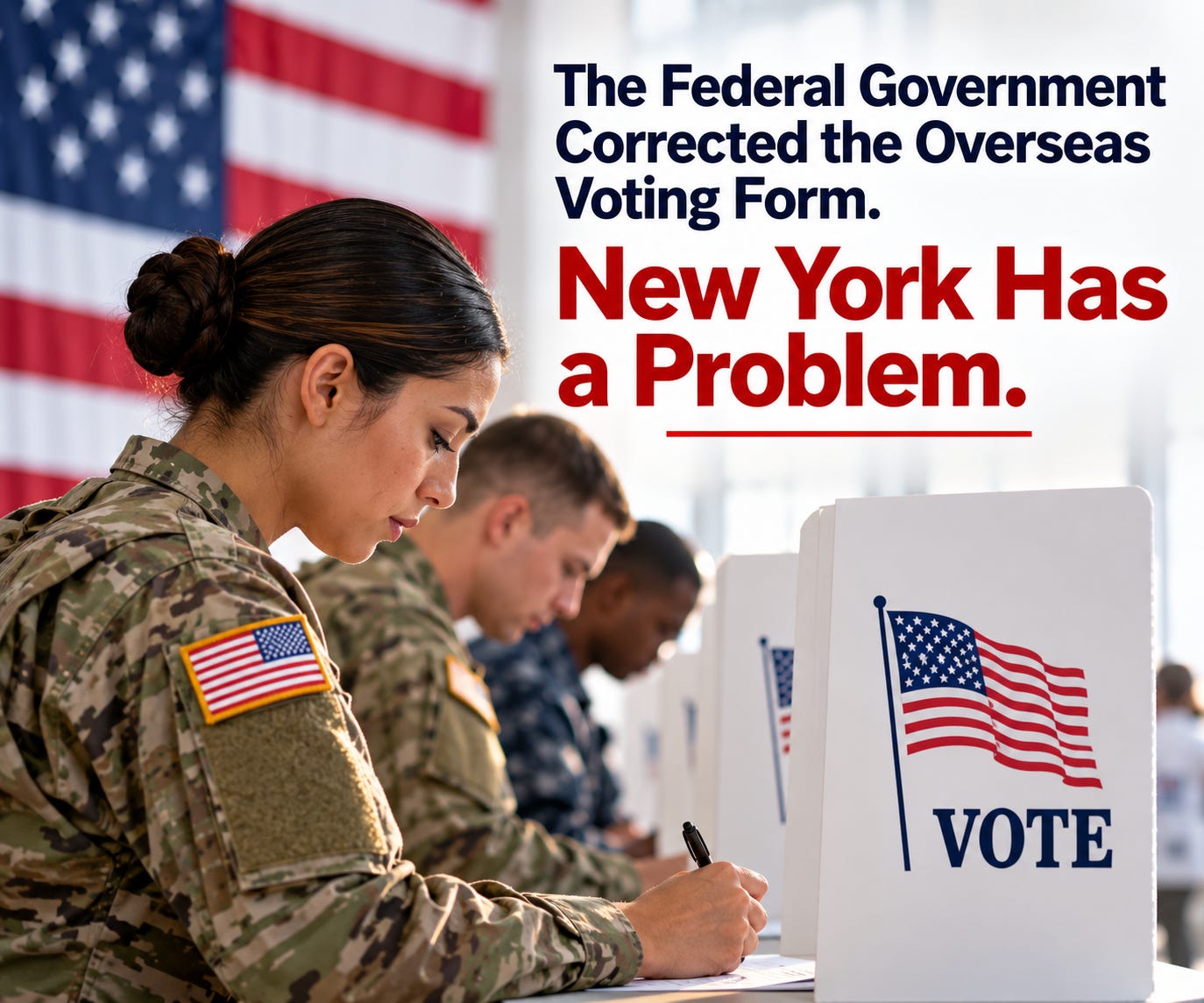
The August 2026 FPCA revision removed an eligibility category that was never included in UOCAVA. New York separately grants voting eligibility to certain citizens who have never lived in the United States, but questions remain about how New York administers and verifies that state-created eligibility.
For years, the Federal Post Card Application (FPCA) included an eligibility category for a U.S. citizen living overseas who had never lived in the United States.
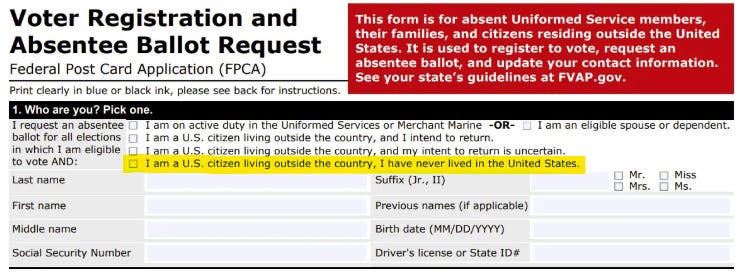
In August 2026, the federal government removed it.
The change was deliberate.
In seeking emergency approval from the Office of Management and Budget (OMB), the Department of War stated that revisions to the FPCA and Federal Write-In Absentee Ballot were necessary to eliminate voter confusion and ensure that the federal forms “strictly comply” with the Uniformed and Overseas Citizens Absentee Voting Act (UOCAVA) and the Help America Vote Act (HAVA).
Among the corrections identified by the Department was the removal of:
“an inaccurate eligibility checkbox for citizens who have never lived in the U.S.”
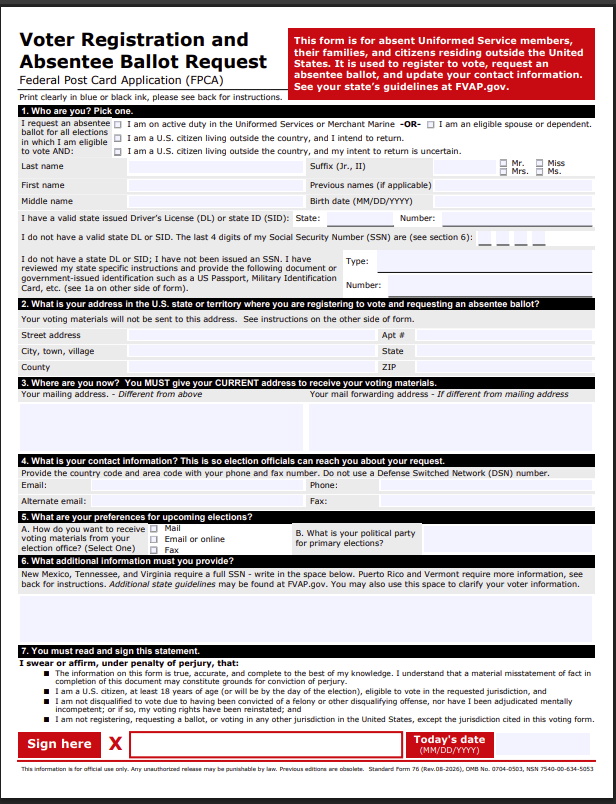
OMB approved the revised FPCA on August 28, 2026.
The correction exposes a longstanding distinction:
Citizens who have never resided in the United States are not included in UOCAVA’s statutory definition of an overseas voter.
States may separately extend voting eligibility to certain never-resided citizens.
New York has done exactly that.
But state-created eligibility is not the same as federal UOCAVA status, and it does not expand the categories Congress placed within UOCAVA.
What UOCAVA Actually Covers
The Uniformed and Overseas Citizens Absentee Voting Act establishes federal voting protections for members of the uniformed services, qualifying family members, and qualifying U.S. citizens residing outside the United States.
For civilian overseas voters, Congress provided a specific definition.
Under 52 U.S.C. § 20310(5), an overseas voter includes a person residing outside the United States who is qualified to vote—or, but for residing overseas, would be qualified to vote—in:
“the last place in which the person was domiciled before leaving the United States.”
The federal definition is based on the voter’s own prior U.S. domicile.
A citizen born overseas who has never lived or established domicile in the United States has no “last place” in which that person was domiciled before leaving the country.
Never-resided citizens therefore do not fall within this statutory definition.
This distinction predates the 2026 FPCA revision.
In a 2017 policy brief specifically addressing never-resided citizens, the Federal Voting Assistance Program (FVAP) explained that UOCAVA eligibility for an overseas citizen is based upon the jurisdiction where that individual resided before leaving the United States. FVAP separately identified never-resided citizens as individuals who “do not fall under the traditional UOCAVA ‘overseas voter’ definition.”
FVAP reported that numerous states nevertheless allowed never-resided citizens to vote based upon the former domicile of a parent or legal guardian.
Those voting rights came from state law, not from an expansion of UOCAVA.
New York Created Its Own Eligibility Category
New York is one of the states that enacted a separate eligibility provision.
New York Election Law § 11-200(1-a) provides that a voting-age U.S. citizen residing outside the United States who has never resided within the United States may register and vote as a special federal voter from a parent’s New York address when that parent qualifies as a special federal voter under § 11-200(1).
The provision does not simply allow a never-resided citizen to claim New York because a parent once lived here.
The parent must qualify under § 11-200(1).
That subdivision requires, among other conditions, that the parent’s last domicile in the United States immediately before leaving the country was in New York.
The statutory structure is clear.
The never-resided citizen does not qualify because he or she previously lived in New York.
The individual qualifies because New York law permits that person to derive a voting address from a parent who satisfies the requirements of § 11-200(1).
That is a New York eligibility rule.
It is not part of UOCAVA’s federal definition of an overseas voter.
UOCAVA Is More Than a Voting Address
UOCAVA establishes federal rights and imposes federal obligations concerning covered voters in federal elections. Those protections include federal registration and absentee-ballot procedures and requirements governing the transmission of ballots.
Congress attached those federal protections to the categories of voters defined by federal law.
New York can establish additional voting eligibility under New York law. But a state-created eligibility category does not itself amend 52 U.S.C. § 20310 or expand the class of voters Congress placed within UOCAVA.
New York’s Election Law separately provides procedures and privileges for people registered as special federal voters under Article 11. Section 11-204 establishes procedures for processing applications and transmitting special federal ballots, while § 11-212 establishes New York’s receipt deadlines for those ballots.
Federal UOCAVA protections and rights or procedures independently provided by New York under Article 11 therefore have separate statutory sources.
The Old FPCA Blurred That Distinction
The previous FPCA included an eligibility checkbox for a citizen who had never lived in the United States.
That placed never-resided citizens on the same federal application alongside voters whose eligibility fell within UOCAVA.
But there was no corresponding never-resided category in UOCAVA itself.
FVAP had acknowledged that distinction years earlier. Eligibility for never-resided citizens depended upon whether an individual state had enacted a law allowing them to vote.
In August 2026, the federal government corrected the form.
The Department’s emergency submission to OMB stated that the revisions were necessary to make the forms “strictly comply” with UOCAVA and HAVA and specifically identified the need to remove the “inaccurate eligibility checkbox for citizens who have never lived in the U.S.”
The revised FPCA no longer presents never having lived in the United States as a federal eligibility category.

New York Still Has a Never-Resided Voter Law
The federal correction did not repeal New York Election Law § 11-200(1-a).
New York remains free, subject to applicable federal and constitutional requirements, to establish voter qualifications under state law.
The problem is administrative.
New York created an eligibility category outside UOCAVA’s federal definition while integrating those voters into its “special federal voter” framework.
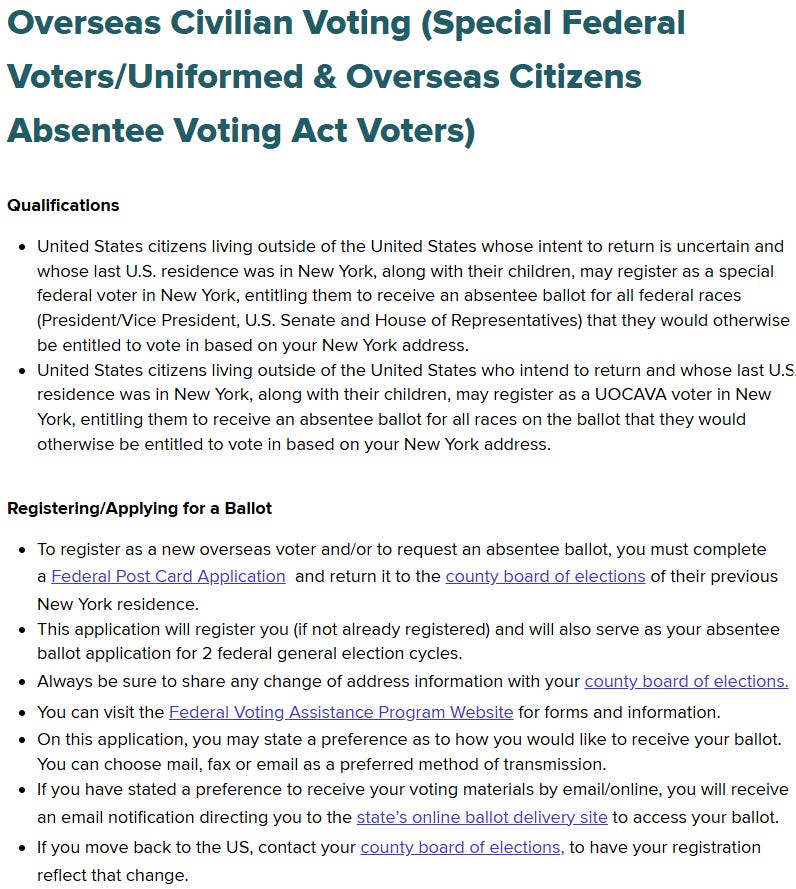
The New York State Board of Elections currently describes overseas civilian voters as “Special Federal Voters/Uniformed & Overseas Citizens Absentee Voting Act Voters.”
Its website states that U.S. citizens living overseas whose last U.S. residence was New York, “along with their children,” may qualify under New York’s overseas-voting provisions.
As of this writing, the New York State Board of Elections website is still hosting the January 2023 version of the FPCA—the superseded federal form containing the “never lived in the United States” eligibility checkbox that was removed from the revised August 2026 form. New York therefore continues to make available a federal form containing an eligibility category the federal government has now expressly removed as inaccurate.
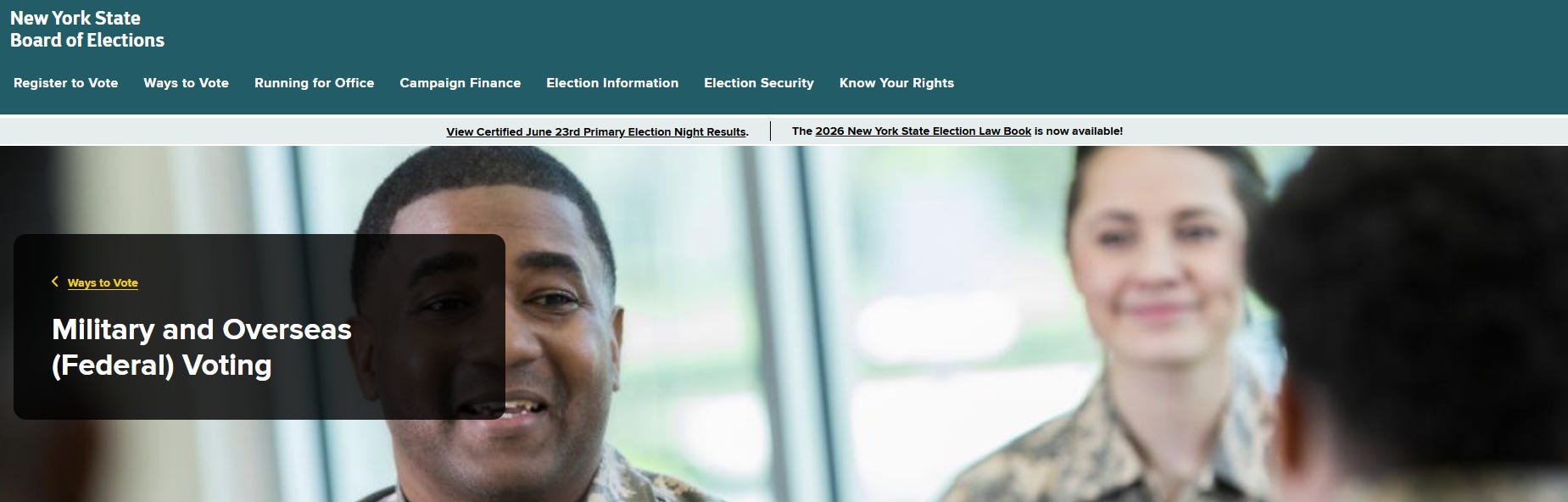
The federal government has now removed the FPCA checkbox that previously accommodated a person who never lived in the United States because it determined that the checkbox did not accurately reflect federal eligibility.
New York must now administer the separate eligibility that New York itself created.
How Does New York Establish Eligibility?
Eligibility under § 11-200(1-a) depends upon the applicant having a parent who qualifies under § 11-200(1).
The parent’s qualifying New York domicile is therefore not merely an address supplied for administrative purposes. It is part of the statutory basis for the never-resided applicant’s eligibility.
Establishing eligibility requires determining at least two critical facts:
Is the person identified by the applicant actually the applicant’s parent?
Was that parent’s last U.S. domicile immediately before leaving the United States actually in New York?
The Election Law does not appear to prescribe specific documentary evidence that must accompany the application to prove either fact.
What Does New York Law Require the Applicant to Provide?
Election Law § 11-202(2)(a) requires the applicant to sign the application and provide “all of the facts required to establish” the applicant’s qualifications.
Section 11-202(2)(b) further requires the application form to elicit the information necessary to determine eligibility.
But the statute does not specify that a never-resided applicant must submit a birth certificate, parental identification, the parent’s former voter-registration record, property records, tax records, proof of residence, or other documentary evidence establishing the parent’s former New York domicile.
The eligibility determination is then placed with the county Board of Elections.
Under Election Law § 11-204(2):
“Upon receipt of an application, the board of elections shall determine upon such inquiry as it deems proper” whether the application is complete and whether the applicant is legally qualified to receive and vote a special federal ballot.
The statute therefore requires an eligibility determination but does not prescribe a uniform documentary standard for making it.
What Constitutes a “Proper” Inquiry?
The scope of the county BOE’s inquiry is central to understanding how § 11-200(1-a) operates in practice.
Does the county independently verify the parent’s former New York domicile?
Does it search historical voter-registration records?
Must the applicant establish the parent-child relationship?
Is a birth certificate or comparable record requested?
Is documentary proof of the parent’s former New York residence required?
What happens when the parent left New York decades earlier?
What if the parent was never registered to vote in New York?
What happens when the address supplied by the applicant cannot be independently confirmed?
And is the applicant’s signed representation accepted as sufficient evidence of these facts, or is independent verification required?
The statutory provisions reviewed do not establish a specific statewide documentary standard for these determinations. Sections 11-202 and 11-204 require the applicant to supply the necessary facts and authorize the county BOE to conduct the inquiry it considers proper.
That does not establish that counties rely solely on attestation. Counties may have additional procedures, and the State Board of Elections may have issued guidance or training materials governing these determinations.
If such standards exist, they should be identifiable.
Sixty-Two Counties Should Not Mean Sixty-Two Standards
New York administers elections through county Boards of Elections, but voter eligibility is established by law.
A never-resided applicant in Erie County should not face a fundamentally different evidentiary standard from an identically situated applicant in Albany, Nassau, Monroe or any other county.
If one county verifies parental domicile through historical voter records, another requires documentary evidence, and another accepts an applicant’s representation without independent verification, similarly situated applicants could be subjected to materially different eligibility procedures.
The State Board of Elections should therefore be able to identify the statewide standards governing:
verification of the parent-child relationship;
verification of the qualifying parent’s identity;
verification of the parent’s last U.S. domicile;
documentation, if any, required from the applicant;
independent records county BOEs are expected to examine;
treatment of applications where the parent’s prior New York domicile cannot be confirmed;
records retained to document the county’s eligibility determination; and
procedures following the August 2026 revision of the FPCA.
These are basic questions of uniform election administration.
The Federal Correction Forces the Issue Into the Open
The legal framework is now clear.
UOCAVA defines civilian overseas voters by reference to their own prior U.S. domicile.
Citizens who have never resided in the United States do not have such a prior domicile and were not included in that federal definition. FVAP recognized this distinction years before the 2026 FPCA revision.
New York independently chose to extend voting eligibility to certain never-resided citizens through Election Law § 11-200(1-a).
The federal government has now removed the FPCA checkbox that treated never-resided status as an eligibility category, expressly describing that checkbox as inaccurate.
New York’s statute remains.
So do the responsibilities that accompany it.
If New York grants voting eligibility based upon a parent’s former New York domicile, the state should have a clear, uniform and documented method for determining whether that statutory prerequisite has actually been satisfied.
Project CIVICA is continuing to examine how New York administers these registrations, including through Freedom of Information Law requests seeking the policies, instructions, training materials, verification procedures and records used by state and county election officials.
The questions are straightforward:
What must a never-resided applicant prove?
What does the county verify?
What documentation is required?
What constitutes the “inquiry” required by Election Law § 11-204?
Are the same standards being applied across New York’s 62 counties?
The federal government has corrected its form.
New York should be able to show how it verifies eligibility under the law New York created.
Sources
52 U.S.C. § 20310 — UOCAVA Definitions
The federal statutory definition of an “overseas voter,” including the requirement based on the voter’s last U.S. domicile before leaving the United States. This is the foundation for explaining why a person who has never resided in the United States does not fit that particular statutory domicile definition. U.S. Code
52 U.S.C. § 20310 — U.S. House Office of the Law Revision CounselFederal Voting Assistance Program — Never Resided Policy Brief (2017)
Particularly useful because FVAP directly discusses U.S. citizens who have never resided in the United States and explains that state law determines whether such individuals may vote. FVAP
FVAP — Never Resided Policy BriefOMB — August 2026 FPCA Emergency Revision
This is probably your most important source for the 2026 change. The federal submission states that the FPCA/FWAB revisions were intended to ensure the forms “strictly comply” with UOCAVA and HAVA and specifically identifies removal of an “inaccurate eligibility checkbox for citizens who have never lived in the U.S.” OMB approved the revision on August 28, 2026. RegInfo.gov
OMB — FPCA Emergency Revision RecordOMB — Supporting Documents and Signed Emergency Justification Letter
This page contains the actual August 28 signed Emergency Justification Letter as well as the supporting statement. RegInfo.gov
OMB — FPCA Revision DocumentsGSA — Current Federal Post Card Application (SF-76)
The authoritative federal forms page identifies the current revision as 08/2026 and says the page was last updated September 1, 2026. This establishes what the current FPCA is. U.S. General Services Administration
GSA — Current Federal Post Card Application (FPCA)New York Election Law § 11-200 — Special Federal Voter Qualifications
This is the critical New York statute. Subdivision 1 covers overseas citizens whose last U.S. domicile was New York. Subdivision 1-a expressly allows a voting-age U.S. citizen who has never resided in the United States to register and vote from a qualifying parent’s New York address. NYSenate.gov
NY Election Law § 11-200New York Election Law § 11-202 — Registration and Application
Important for your verification discussion. It requires the applicant to provide the facts necessary to establish eligibility and says the prescribed forms must elicit the information necessary to determine eligibility. NYSenate.gov
NY Election Law § 11-202New York Election Law § 11-204 — Processing Applications
This governs county BOE processing. It also expressly addresses treatment of an FPCA submitted by someone qualified as a New York special federal voter. This is important to the article’s discussion of how New York administers its state-created category. NYSenate.gov
NY Election Law § 11-204New York State Board of Elections — Military and Overseas (Federal) Voting
The current NYSBOE webpage says overseas citizens whose last U.S. residence was New York, “along with their children,” may qualify, and it instructs a new overseas voter to complete a Federal Post Card Application. This is particularly relevant to the administrative issue raised in your article. New York State Board of Elections
NYSBOE — Military and Overseas (Federal) VotingFPCA Currently Hosted on the NYSBOE Website — January 2023 Version
This is the source for the paragraph you just added. As of October 1, 2026, NYSBOE is still hosting SF-76 Rev. 01-2023, which contains the checkbox stating: “I am a U.S. citizen living outside the country, I have never lived in the United States.” The form itself also states that previous editions are obsolete. New York State Board of Elections
FPCA currently hosted by NYSBOE — Rev. 01-2023